Last week we sat down with Dr. Sonya to learn about her early influences and educational background. This week we dive into her career trajectory after she completed her PhD.

Dr. Sonya looks on as gorillas explore the forest enclosure at GRACE in 2017. Photo by Liz Williamson
REMINDER!
Gorilla Doctors LIVE: Meet + Greet with Dr. Sonya
Thursday, April 9 9:00 – 10:00 am PDT | 12:00 – 1:00 pm EDT
Join us in conversation with Dr. Sonya as she and Dr. Jan Ramer, Gorilla Doctors’ Board Chair, discuss a wide variety of topics from great ape conservation, leadership, Dr. Sonya’s first month on the job, and so much more! With time for an audience Q&A, this is your chance to come with questions and ‘meet’ Dr. Sonya. Free and open to all with advanced registration.
1) You finished your PhD on chimpanzees in Uganda. What happened next?
I had a post-doctoral position to continue working on chimpanzee behavioral research in Kibale National Park, Uganda then taught in the biology and anthropology departments at Bates College in Maine for five years. Additionally, I continued with the snare removal program at Kibale and helped set up a U.S. nonprofit organization for the Gunung Palung Orangutan Conservation Program – which protects orangutans in and works with communities around Gunung Palung National Park, Indonesian Borneo, where I also studied orangutans while in graduate school. In 2013, I joined the Gorilla Rehabilitation and Conservation Education Center (GRACE) as its first Executive Director.
2) Give us the backstory on how GRACE first came to be. Was this your first introduction to Gorilla Doctors?
By 2010, several gorilla orphans, both mountain and Grauer’s, had been confiscated from poachers by wildlife authorities and were being cared for in temporary facilities, assisted by Gorilla Doctors and Dian Fossey Gorilla Fund. The infants needed around-the-clock care. It was at this time Dr. Eddy was hired by Gorilla Doctors to care for the orphans located in Goma, DR Congo.
GRACE was established to provide long-term care for the orphaned Grauer’s gorillas and began construction on a dedicated facility in DR Congo. And it was through GRACE that Dr. Eddy and I first met! Gorilla Doctors continued providing supportive veterinary care after the orphans transferred to their new home at GRACE, and even still today Gorilla Doctors collaborates on annual health examinations and emergency care of the orphans.
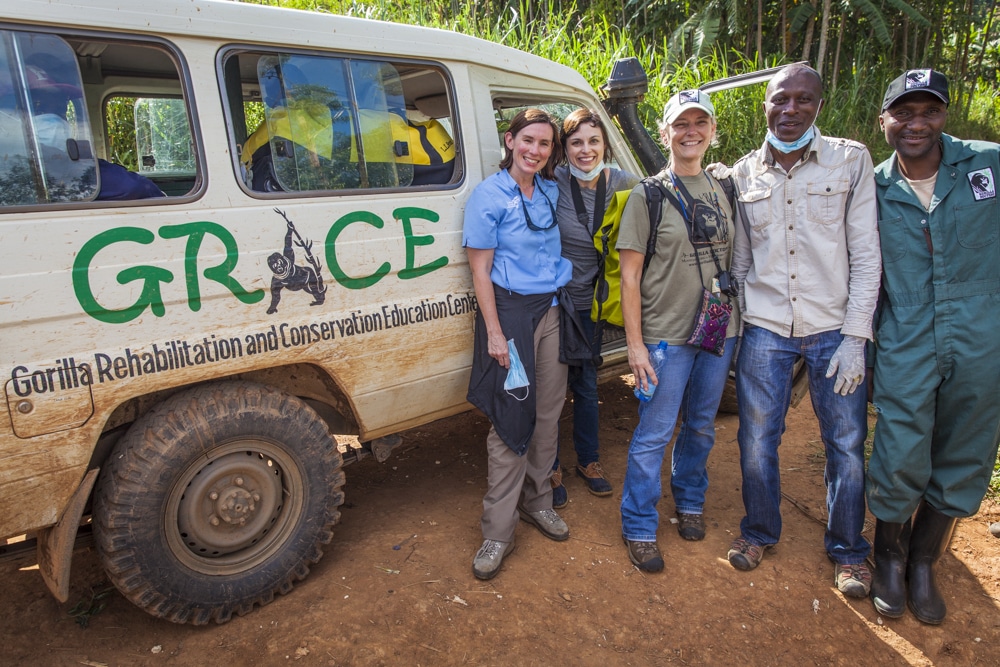
Transfer team that helped coordinate move of Grauer’s gorilla orphan Ihirwe from Rwanda to DR Congo in 2014. Dr. Natalie Mylniczenko (GRACE veterinary advisor), Dr. Sonya (then GRACE ED), Dr. Jan Ramer (then Regional Veterinary Manager for Gorilla Doctors), Jackson Mbeke (GRACE Country Director), and Dr. Eddy Syaluha (Head Veterinarian, DR Congo for Gorilla Doctors).
I was brought on as GRACE’s first Executive Director, tasked with building the organization from the ground up. The founding vision had always been the eventual rewilding of the Grauer’s gorilla orphans. What began as a small project with a big vision grew over time, through close collaboration with Congolese staff, community partners, and international advisors. Today, GRACE is a leading organization in gorilla sanctuary care and conservation.

Dr. Sonya presenting at the International Wildlife Reintroduction Workshop, Chicago, 2018.

Drs. Sonya and Eddy with Dr. Eddy’s son in DR Congo, 2018.
That growth has continued, with major milestones achieved along the way, including strengthened protection for wild great ape habitat surrounding GRACE and, most recently, the fruition of GRACE’s original vision – a return to the wild of four adult female orphans in 2024 by GRACE, Virunga National Park, Gorilla Doctors, and Congolese wildlife authorities. Read the full story of their transfer and release to the Mt. Tshiaberimu sector of Virunga National Park HERE.
3) Having been the founding executive director for GRACE, how does it feel to see those four females thriving in the wild?
I’m incredibly proud of the Congolese team. Their hard work, resilience, and dedication in the face of many challenges are what brought GRACE to this important milestone. I’m also grateful for the long-term commitment of the many supporters and partners who made everything at GRACE, and ultimately this rewilding, possible. I love watching GRACE continue to grow and thrive as an organization.
In addition, I’m so happy that four female gorillas now have a second chance to live in the wild. Since humans were responsible for removing them from their natural habitat, helping them return feels like the right thing to do. While reintroduction isn’t possible for every great ape in sanctuary, this case shows what can be achieved when the right conditions come together. I believe this effort will generate many valuable insights that will inform how we manage great ape populations in the years ahead.
3) You left GRACE in 2019. Tell us about some of your other experiences since then.
I had the opportunity to live in Costa Rica with my family, where I contributed to local conservation efforts for iconic wildlife like tapirs and parrots through board and consulting roles. I also held several nonprofit leadership positions that have kept me closely connected to Africa, One Health, and community and great ape conservation. Most recently, I served as Interim Executive Director for The Kasiisi Project, which brought me back to Kibale National Park in Uganda.
4) Gorilla Doctors and GRACE still work closely together; does it feel a little like coming full circle stepping into the Executive Director role for Gorilla Doctors?
I’m excited for the opportunity to work again with GRACE and with many familiar partners in the region and wider wildlife conservation community. I’m also looking forward to building new relationships through this role and continuing to expand my knowledge.
One of the most rewarding aspects of my time at GRACE was learning about the veterinary care of the sanctuary’s gorillas. Although my role at Gorilla Doctors is focused on organizational leadership, I’m already learning from our exceptional veterinary and research teams, as well as from our partners at the Karen C. Drayer Wildlife Health Center and One Health Institute at the University of California, Davis School of Veterinary Medicine.
Next week, in Part 3 of our series, we’ll explore Dr. Sonya’s vision for the future of Gorilla Doctors as well as the challenges and opportunities ahead for great ape health and conservation…stay tuned!


