Last week our board chair, Dr. Jan Ramer, introduced you to Dr. Sonya Kahlenberg, our new executive director. In part one of this three-part Q&A series, discover Dr. Sonya’s childhood inspirations, educational background, and early formative experiences.
1) What sparked your love of animals and nature?
I grew up on a small farm in Ohio, so animals were always a part of my everyday life. My father was a farmer, and we cared for a collection of animals (pigs, sheep, chickens, cows, goats, and more), mainly for our 4-H projects. I loved being around animals and wanted to be a veterinarian.
In high school, I volunteered with our family’s vet and the veterinary department at my local zoo. The zoo was my happy place as a teen. I started working there during the summers as a zookeeper in the children’s zoo and other various jobs like selling tickets and even driving the train! Anything to keep me closer to the animals.
2) Do you have a specific memory of when you first learned about or became enamored with great apes?
I think it was in middle school. We had to do a project on an endangered species, and I chose mountain gorillas. I still have the handwritten notecards that I used to give my presentation to the class. That was the late 1980s when mountain gorilla numbers were critically low. I remember feeling worried and wishing I could do something to help. I guess I never got rid of that feeling.
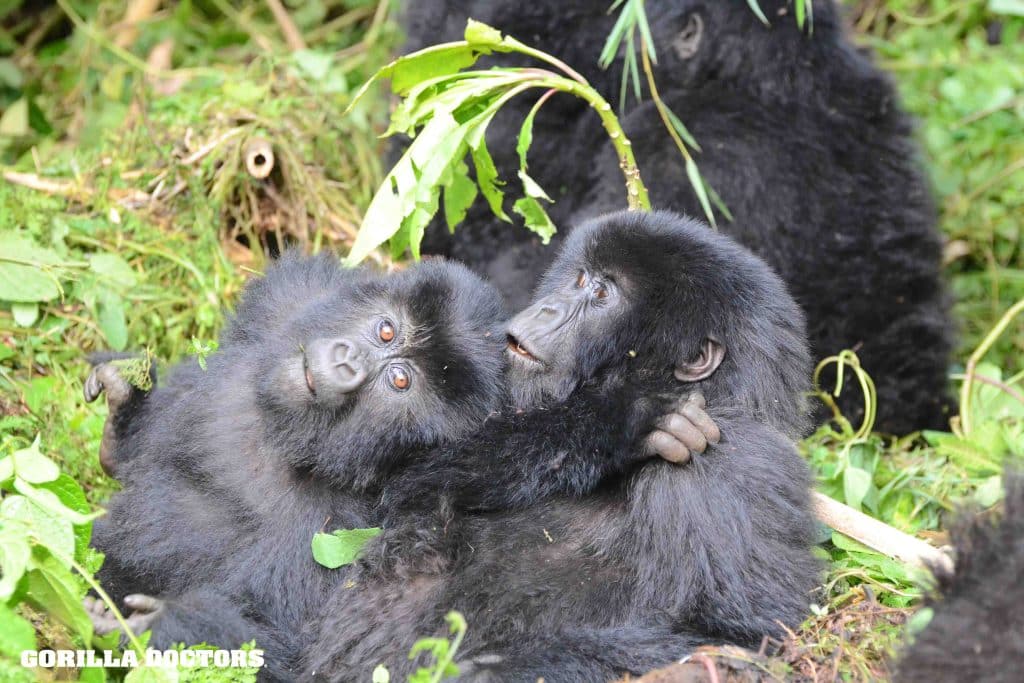
Infant mountain gorillas, Isimbi group, Volcanoes National Park, Rwanda, 2019. © Gorilla Doctors
3) What made you want to pursue science as a career path?
My farm upbringing influenced my decision to be a pre-vet major, but in my first year of college, I discovered animal behavior research, and that sealed the deal for what I wanted to do! I had a zoology professor who was an important mentor, and he encouraged my interest in animal behavior and primatology. I worked on his bird research too, which ignited a love of birding that is still with me today.
During my undergraduate years, I pursued every opportunity to work with primates. I volunteered with great apes at the zoo, helping the keepers with their daily tasks and making enrichment items to support the apes’ wellbeing. Through my zoo connection, I had the opportunity to go to Borneo to help care for orangutan orphans when I was 19. Deforestation and mining were accelerating in Borneo at the time, resulting in hundreds of orphaned orangutans flooding into rescue centers and sanctuaries. I also spent a summer studying lemurs at Duke University’s Lemur Center, which resulted in my first scientific paper.
4) Tell us a little about your graduate research. What was it like working in the field with wild chimpanzees?
I conducted my PhD fieldwork in Kibale National Park, Uganda with the Kibale Chimpanzee Project–one of the longest-running studies of wild chimpanzees. Studying chimpanzees was fascinating, physically demanding, and always an adventure. We woke before dawn and followed the chimpanzees throughout their day as they went about their lives–feeding, traveling, grooming, and socializing—until they built their nests in the trees at night. My favorite time of day was in the early morning sitting under the nests waiting for the chimpanzees to wake up and witnessing the whole forest come alive as the sun rose.

Kahlenberg at Kibale National Park, Uganda. © Sonya Kahlenberg
Chimpanzees live in a “fission–fusion” society, meaning individuals frequently split into smaller subgroups and then come back together over the course of the day. My research focused primarily on females, so I spent much of my time observing mothers and their young.
Observing the chimpanzees’ intelligence, emotions, and social bonds up close was an incredibly special experience—one that didn’t just deepen my understanding, but also made me feel a strong sense of connection and responsibility for the future of our closest living relatives.
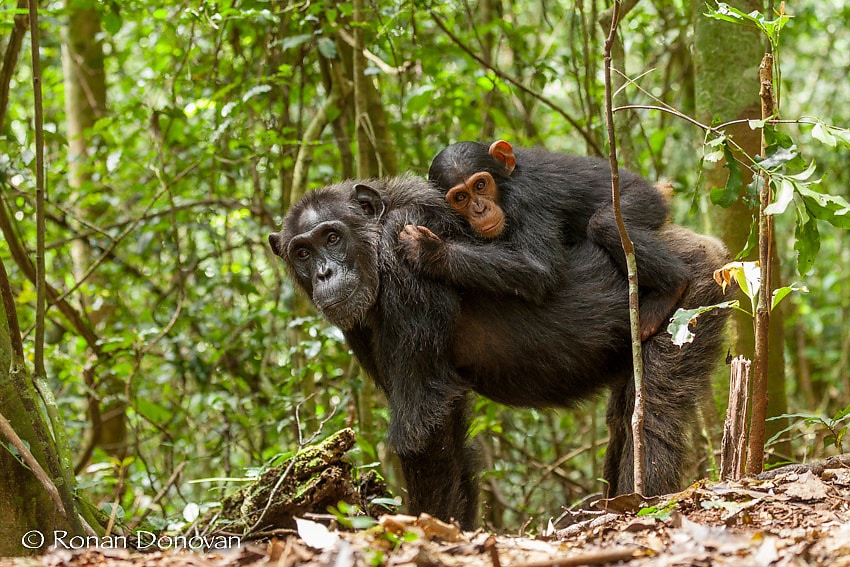
Female Outamba with offspring in Kibale National Park, Uganda (Ronan Donovan/courtesy of Kibale Chimpanzee Project).
5) You weren’t originally ‘studying’ conservation – when did this shift/awareness come?
While working in Kibale, we also confronted a troubling reality: about 30% of the chimpanzees we studied had lasting, and sometimes debilitating, injuries to their hands or feet from snares illegally set in the forest to catch animals such as small antelope. One chimpanzee, Max, even lost both of his feet to snare injuries. Remarkably, he is still alive today, though his life remains extremely challenging.

Chimpanzee named Max with amputated feet from snare injuries, Kibale National Park, Uganda (© Ronan Donavan/courtesy of Kibale Chimpanzee Project).
Witnessing this firsthand motivated me to look for ways to help address the problem. I began managing, alongside my Ugandan colleague, Kibale Chimpanzee Project’s initiative to send teams into the park to locate and dismantle snares, reducing the risk to chimpanzees and other wildlife.That experience ultimately shifted my focus toward conservation. It also revealed the complexity of conservation challenges and reinforced the importance of partnering with communities and taking a holistic, integrated approach to solving them.
Next week, find out what led Dr. Sonya away from chimpanzees and toward a ground-breaking, first of its kind organization in DR Congo…
Want to dive even deeper? Come ‘meet’ Dr. Sonya live on Zoom – Thursday, April 9 at 9:00am PDT | 12:00pm EDT
This event is free and open to all with registration. Can’t attend live? Register and be the first to receive the recording.
REGISTER HERE