Dr. Nelson Bukamba, one of our field veterinarians in Uganda, recently published his first peer-reviewed scientific paper from his master’s thesis, which focused on the health risks of Strongyloides parasites:
Bukamba, Nelson, et al. “The potential threat of Strongyloides spp. to mountain gorillas and public health in Bwindi Impenetrable National Park, Uganda.” Parasitology Research (2026).
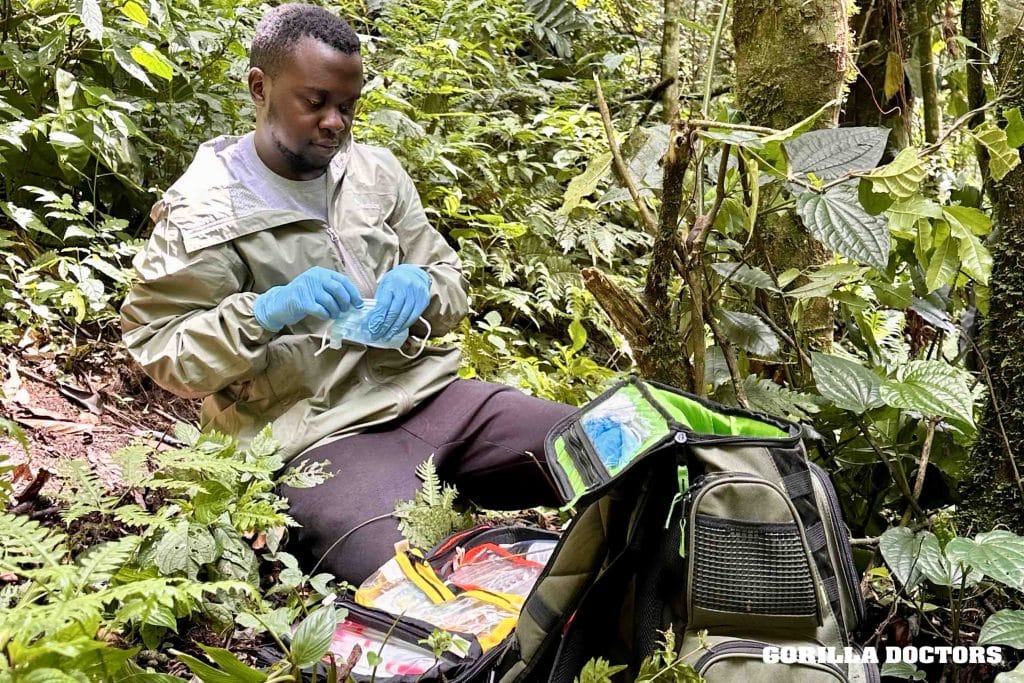
Dr. Nelson prepares medication for a mountain gorilla intervention, Bwindi Impenetrable National Park, Uganda. © Gorilla Doctors
This research was conducted in collaboration with the Czech Academy of Sciences Institute of Vertebrate Biology, and co-authors also included Gorilla Doctors staff Drs. Benard, Fred, Ricky, Tierra, and Kirsten.
We sat down with Dr. Nelson to learn more about his research and findings.
Q: Dr. Nelson, congratulations on publishing your first scientific paper! Before we dive into the science, tell us, how did it feel to have your paper accepted?
A: Thank you so much! When I learned that my first scientific paper had been accepted, I was overwhelmed with excitement and relief. Months of research, writing, and numerous revisions suddenly seemed worthwhile when I received that acceptance email. I had dreamed of reaching this milestone for a long time, and now it fills me with pride and renewed motivation to explore the world of research further.
Q: You analyzed fecal samples collected from mountain gorillas, olive baboons, domestic dogs and pigs for the presence of soil-transmitted Strongyloides in and around Bwindi Impenetrable National Park, Uganda. Can you tell us what methods you used?
A: We used coproscopy, which is looking at the samples under a microscope. We also utilized real-time PCR genetic sequencing to identify individual Strongyloides at the species level. This was the first-ever attempt to genetically identify the different species. Previous studies mainly used coproscopy only. By combining both techniques, we can provide much stronger evidence for parasite identity and cross-host overlap. In fact, the study uncovered much higher parasite prevalence than previously detected and revealed how these infections cross species boundaries. It really highlighted the importance of molecular diagnostics in wildlife disease surveillance for us.
Q: What does ‘cross-host overlap’ mean?
A: Since 2018, we have observed an increase in gastrointestinal parasite infections in mountain gorillas. Part of trying to understand this increase is to study the various animals in the ecosystem that are susceptible to the same parasites. So, cross-host overlap is when multiple species of animals can be infected by the same parasites.
Q: What were some of your findings?
A: Baboons had the highest infection rates and egg counts. We also found that young gorillas were especially vulnerable to infection. Gorillas that range near the forest edge, where wildlife, people, and domestic animals interact more, were more than twice as likely to be infected. Genetic evidence showed that gorillas and baboons likely share parasite strains, further supporting cross-species transmission. Finally, we also discovered a domestic dog carrying a Strongyloides lineage that can infect dogs, humans, and primates.

Microscopic image of a parasite in a baboon sample. © Gorilla Doctors
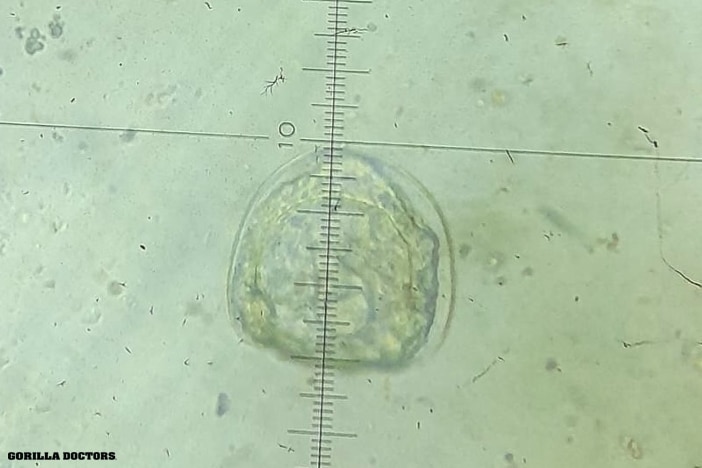
Microscopic image of a tape worm in a mountain gorilla sample. © Gorilla Doctors
Q: What do these findings mean?
A: The above findings suggest that when we have more overlap between humans and wildlife, and where we can also encounter higher sanitation challenges seems to be a transmission hotspot. Additionally, that baboons and gorillas shared specific parasite strains is strong evidence of cross-species transmission.
Q: How do these findings help us keep gorillas healthy?
As a matter of fact, the health of gorillas is inseparable from the health of the people and domestic animals who share their environment. As human settlements expand closer to protected areas, the risk of cross-species disease transmission continues to rise, making infectious diseases one of the most pressing threats to great ape conservation. Increasing our understanding of the parasites in the ecosystem and how they are impacting gorilla health can also help inform and refine protocols for when we need to treat a gorilla for gastrointestinal parasite-related illness.
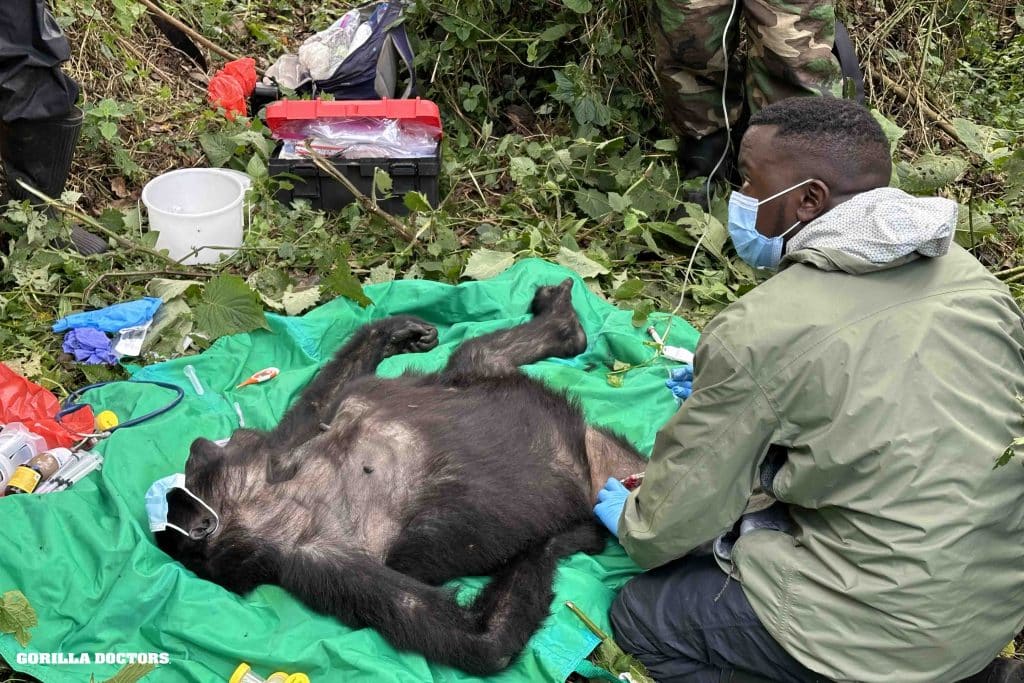
Dr. Nelson treats mountain gorilla in Bwindi Impenetrable National Park, Uganda. © Gorilla Doctors