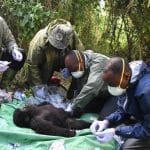
We got a call from trackers that Agahozo, a 5 year old male gorilla in Pablo group, was coughing and staying behind the group. This is the season when we begin to worry about respiratory disease in the gorillas – the end of the rainy season. It has been rainy and cool recently, and Pablo group is very high on the volcano so it is very cold where they live. We were concerned. Dr. Jean Felix went up to assess Agahozo last Thursday and while he was coughing a bit, and moving a bit slowly, he was not in a life threatening situation. We decided to wait it out, getting reports from the field daily. Unfortunately the next day news was not good – Agahozo had a wound on his neck that smelled bad and was he was far behind the group. We consulted with the researchers at Karisoke Research Center (Pablo is one of the research groups) and with the officials at Park Headquarters, and we all agreed that this was a situation that may require an intervention – either to give antibiotics through a dart, or even anesthetize with a dart for full physical exam and treatment.
I had been in the United States for the previous 2 weeks and so was technically in quarantine in order to protect the gorillas from any international virus I might be carrying. But in this situation we needed all hands on deck – Pablo group has 47 individuals with 3 silverbacks including Cantsbe, one of the oldest and wisest silverbacks in the area. We needed to be very careful. Dr. Magda, Dr. Jean Felix, Dr. Fred and I headed up to the group early the next morning along with Joel from Karisoke and many very experienced trackers. Of course if we decided to do an intervention once we got to the group and re-assessed Agahozo, we would all be garbed in masks and gloves, to protect both ourselves and gorillas from any exchange of disease.
It was a long, difficult climb. We trudged up the slopes of Visoke for over 5 hours, through mud up to our knees and beyond, up and down steep, muddy ravines, over a raging river, finally finding the group above the tree line (above 10,000 feet), eating on either side of a deep ravine. I was exhausted – I had not been in the forest for almost a month, and had not yet re-acclimated to the altitude. Drs. Magda and Jean Felix were in the advance team (I was definitely in the rear guard…) and the reports were good – Agahozo was bright and alert, in the middle of the group, behaving normally and feeding well! No coughing at all. He was cleaning a wound on his neck that looked to be an abscess that had ruptured – no wonder he felt better! After a brief meeting with everyone involved we decided that there was not a good reason for any intervention. We were all relieved, and started the long walk back to the truck. That day I didn’t even see a gorilla.
I was officially out of quarantine the following Wednesday and planned the next day to visit Group 13. We try to visit every group in the park at least once per month for a visual health check, and Group 13 was next on the list. I was excited to see gorillas again – it had been too long. As always I picked up the trackers at the corner on the way to Kinigi at 6am, and we headed up to the parking area closest to where Group 13 was last seen. It was an easy 20 minute walk through the potato fields to the edge of the park, and another hour though the cool, misty bamboo zone, where the wind was singing in the tops of the bamboo trees. We passed a deep cave, almost a sink hole, in the Kibumbu area that Vincent the tracker told me was full of bats. The cave has another entrance in the ravine below us. I made a mental note to go back and explore the caves at some point. When we reached the gorilla night nests there was a criss-cross of trails leading to and fro, both gorilla and forest buffalo trails. We went up and down the slopes, back and forth across our own trails. Finally the trackers split up while Joseph, my porter, and I waited. After an hour of searching the group was located. They were on a slope above a beautiful small mountain lake called Gasinmdikana.
 The trackers and Joseph, when we finally found the group.
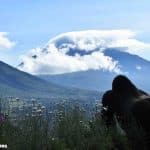
 Gasindikana Lake. There are gorillas in the vine covered tree on the right.
The group was feeding contentedly on vines and thistle, and spread out on the slope. Group 13 has one silverback, Agashya. He keeps watch over a large family of 8 adult females and their children of various ages. The first gorilla we encountered was Gutungura, a 3 year old male. He was swinging from a vine watching us watch him! What a cutie pie.
We moved up the slope and found a number large number of the group settled into the foliage munching on their breakfast. We methodologically went through the group so that I could see each individual. I still can’t identify many individuals, but the trackers know these animals so well.
 How many gorillas can you find?!
 This is Gasindikira, a female named for the place she was born, and her young infant.
 They are always watching us. I wonder if they discuss our behavior when we leave.
 The infants are particularly curious about us.
Today I got a real treat. Munezero had a 4 day old infant, and we found her resting quietly with her newborn and 3 year old boy Ubutwali close by. Munezero clearly adored her new baby, and was very protective.
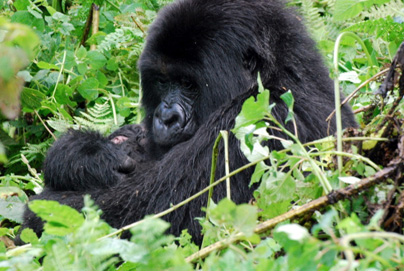 Munezero with her newborn cradled in her arms.
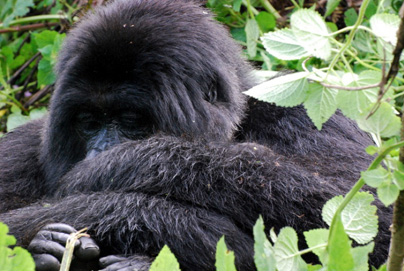 Munezero was resting for much of our visit. You can see the top of the baby’s head under her left arm.
 She was really keeping the new baby close and warm.
 Here’s big brother Ubutwali scratching his head, wondering who this new little gorilla was!
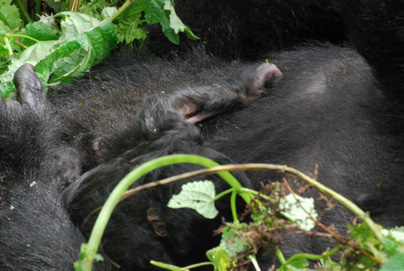 The baby was beginning to hold onto Munezero’s hair, but still had to be supported by Munezero when she walked.
 Agashya, watching his family.
At the end of my health check the mist rolled in, obscuring the lake and forming minute water droplets on the gorillas and us. The trackers stayed to welcome the tourists who were on their way up. Joseph and I headed back to the truck. It had been wonderful visit with Group 13. All the gorillas were healthy, and the new baby was strong. I am glad to be back in Rwanda and back among the gorillas!
 Gasindikana Lake with the mist rolling in.
Help the Gorilla Doctors.