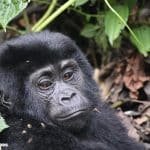
 Kunama on August 8By Dr. Dawn Zimmerman
On August 7, Karisoke Research Center (KRC) reported that 17-year-old adult female Kunama of Ugenda group appeared to have a protruding tongue and difficulty eating. I visited the group the following day and observed the same behavior, although I could not determine the cause of her condition through visual observation. A plan was made for a team to check her again on Thursday and intervene if she showed no improvement.
The next morning, a team including myself, Dr. Jean-Felix Kinani, Elisabeth Nyirakaragire from the Rwandan Development Board, KRC Researcher Winnie Eckardt, and KRC trackers, trekked to Ugenda group. Kunama looked weak and was hunched over, although she was still trying to eat. Her tongue appeared even more swollen and her abdomen was flat, indicating that she had ingested little or no food recently. We needed to intervene.
 Kunama’s convex abdomenWe easily darted Kunama with anesthesia and she fell asleep within minutes without the other gorillas, including two silverbacks, seeming to notice. Kunama appeared to be moderately dehydrated and undernourished so we gave her IV fluids and dextrose.
 Ulcerated lesions on the tongueHer tongue was grossly swollen and protruding from her mouth. There were several ulcerated lesions on her tongue that appeared secondary to the tongue’s enlargement, but I could find no other obvious problems. There were no foreign bodies or masses, and the throat and mouth all appeared normal. We administered IV steroids to help reduce the inflammation of her tongue and antibiotics to treat potential infections.
 Examining KunamaDuring the exam, we also noticed some reproductive abnormalities that may indicate Kunama recently had a miscarriage. She has a five-year-old son, and this would have been her second baby. We can’t tell if the miscarriage is linked to her current feeding problems, but we took many samples to analyze at the laboratory to help us better understand her condition. After the exam, Kunama was given a reversal drug and returned to her group.
There were many possible causes of Kunama’s condition and I consulted with human doctors to help narrow down the list of possibilities since we were unable to perform a wide range of tests in a limited amount of time. Dr. Jean-Felix and the KRC trackers reported, in hindsight, that they had observed Kunama playing with her tongue excessively over the past year, suggesting that her condition might be chronic rather than acute. A chronic inflammatory (deposition) disease seemed like a strong possibility.
On August 10, I returned in the morning to recheck Kunama’s condition. She appeared stronger but with little change in the condition of her tongue and ability to eat. Winnie monitored Kunama for four hours and though Kunama continued trying to eat, she grew weaker as the afternoon went on. Drs. Jean-Felix and Noel arranged to check her again on Saturday to determine if a second intervention was needed.
The next morning, the veterinarians were surprised to see Kunama looking much better. Her tongue was not protruding and she was eating.
 Kunama feeding herself on August 11.Today, Monday the 13th, I went up to see Kunama for myself. She looked well and was eating non-stop. My only concern was that she continued to stick her fingers in her mouth, so her tongue may still be bothering her. Unfortunately, I could not actually visualize the tongue. Perhaps it is not quite yet back to its normal size, and certainly the ulcerated lesions could be a bit painful when she’s eating. I was also unable to visualize her abdomen, but based on her rate of eating, I imagine it will be back to normal in a few days if not already. Otherwise, we are happy with the progress, and will continue to ask the KRC trackers to update us on her status.
In light of this progression, I wonder if perhaps there was a foreign body or allergen that was removed prior to our intervention and it just took longer than expected for the inflammation to be alleviated. However, because many of the possible causes of her inflamed tongue are chronic conditions, we will continue to closely monitor the condition of her tongue in the future.
You can follow the Gorilla Doctors health monitoring efforts on our Facebook page, where we post photos and notes from our monthly visits.
Please consider supporting us by making a secure online donation. Every dollar you give goes to directly supporting our gorilla health programs and One Health initiative. Thank you for your generosity.